
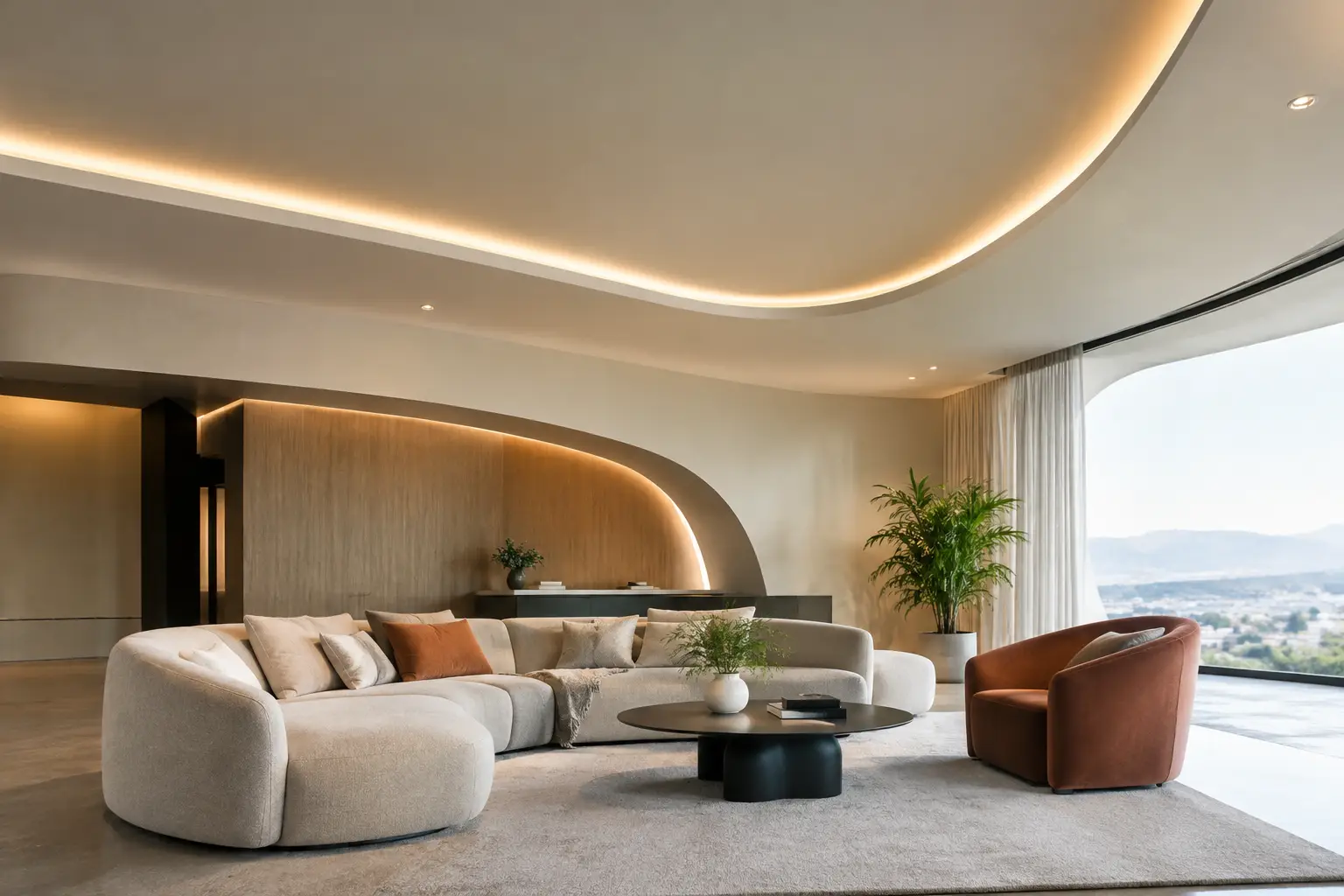
Curved Ceiling Lighting with Vecta Design
Curved ceilings create a sense of openness, movement, and architectural refinement, but their geometry demands careful lighting design. Poorly positioned fixtures can produce glare, uneven brightness, visible interruptions, and awkward transitions. With Vecta Design stretch ceilings, lighting, surfaces, profiles, and concealed services can be coordinated as one architectural system, preserving clean geometry and visual continuity.
Plan Lighting Around Curved Geometry
Unlike flat ceilings, curved surfaces change the distance and angle between light sources and illuminated areas. This affects brightness, beam distribution, and the visibility of individual LEDs. Details that work on horizontal surfaces may create hotspots or dark bands on vaults, domes, coves, and flowing ceiling transitions.
A successful curved ceiling lighting design begins with the intended visual effect. The ceiling may function as a luminous surface, a softly illuminated architectural feature, or a background for directional lighting. Not every curve requires uniform brightness. In hospitality, residential, and retail interiors, controlled illumination often produces a more sophisticated result than maximum output.
Choose the Right Vecta Design Lighting Solution
Vecta Design backlit stretch ceilings create continuous luminous surfaces that can make corridors, reception areas, lounges, and marine interiors feel more spacious. Uniform illumination requires appropriate LED spacing, cavity depth, and membrane translucency. Shallow cavities save ceiling height but increase the risk of visible LED patterns and uneven brightness.
Concealed perimeter lighting emphasizes curved silhouettes while maintaining a softer, darker central plane. Integrated light lines introduce rhythm and direction, following the curve or creating deliberate geometric contrast. Accurate positioning and consistent widths are essential, particularly at transitions.
Vecta Design stretch ceilings are well suited to complex curved geometry. Custom perimeter profiles define the form, while tensioned membranes create smooth, uninterrupted surfaces. The concealed cavity accommodates lighting, wiring, acoustic materials, and building services.
For adjustable directional illumination, Vecta Design magnetic track lighting can highlight merchandise, artwork, furniture, or circulation routes. Tracks should follow the architectural logic rather than dominate the curve.
Control Glare, Reflection, and Light Quality
Curved surfaces reflect and redirect light at changing angles. A concealed source may become visible from another position, particularly in restaurants, hotel lobbies, lounges, and residential spaces.
Evaluate lighting from actual viewing positions and use mockups to verify brightness, uniformity, and glare control.
Material finishes significantly influence the result. Matte membranes soften reflections, satin surfaces provide subtle depth, and mirror finishes increase perceived volume but require precise fixture alignment. Reflective surfaces can amplify unwanted bright spots and visible joints.
Warm white lighting supports relaxed hospitality and residential environments, while neutral white often suits workplaces, retail, and public interiors. Tunable systems can accommodate multiple activities when supported by practical lighting scenes and intuitive controls.
Integrate Acoustics and Building Services
Curved ceiling systems frequently combine lighting, sound control, ventilation, fire protection, and concealed infrastructure. Early coordination prevents technical components from disrupting the finished architectural surface.
Vecta Design acoustic solutions can integrate sound-absorbing treatments behind stretch ceiling membranes, improving acoustic comfort in restaurants, meeting rooms, reception areas, and other interiors with reflective surfaces.
Lighting drivers, detectors, dampers, and control equipment must remain accessible for maintenance. Plan discreet service zones, removable elements, and suitable access points before fabrication.
Ventilation diffusers, sprinklers, and other mechanical components should be coordinated with ceiling profiles and lighting layouts. Late changes can compromise curved geometry, installation efficiency, and visual consistency.
Detail Curved Ceiling Transitions
The quality of a curved ceiling is often determined by its edges. Connections to walls, glazing, joinery, and adjacent ceiling levels require the same precision as the main surface.
Vecta Design ceiling profiles support controlled transitions between curved and straight sections, integrated lighting, and surrounding materials. Resolve profile geometry, membrane tension, lighting cavities, installation tolerances, and service access together.
The most successful curved ceiling lighting solutions are not necessarily the brightest. By integrating Vecta Design stretch ceilings, lighting systems, acoustic treatments, and technical services from the beginning, architects can create comfortable, visually continuous interiors where every curve, light line, and transition serves a clear purpose.