
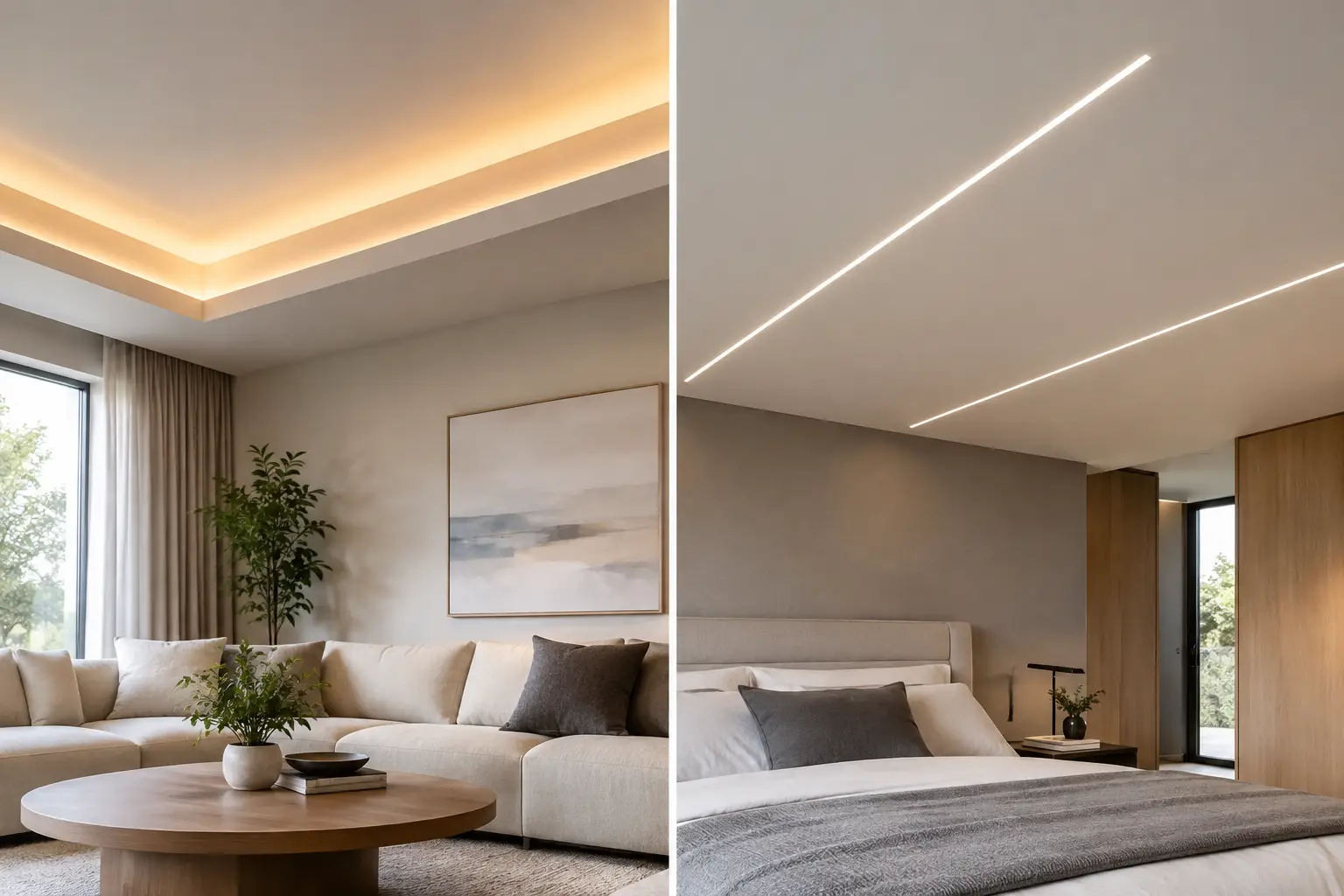
Light Coves vs Light Lines with Vecta Design
Light coves create soft atmosphere; light lines introduce precise geometry. In hospitality, residential, workplace, and retail interiors, Vecta Design stretch ceilings integrate both approaches within a continuous architectural surface.
Choose the Effect and Scale
Coves conceal LEDs within recesses, reflecting light from adjacent surfaces to soften boundaries and generally reduce glare. Light lines use visible diffusers, defining circulation, displays, or functional zones while providing ambient, task, or decorative illumination.
Neither is inherently superior. Match the approach to room proportions, furniture, and viewing angles. Poorly proportioned coves can create bright edges and dim centers; light lines above seating, beds, or tables require careful glare control. Align lighting with walls, joinery, partitions, and architectural axes.
Detail Vecta Design stretch ceilings as a System
Cove depth, setback, beam distribution, and surface reflectance determine performance. Better positioning may improve results more than increased output. Dark or absorbent finishes can reduce indirect lighting efficiency.
For light lines, coordinate profiles and diffusers to avoid visible LED points, dark ends, uneven brightness, and distracting joints. Narrow slots remain subtle; wider channels become stronger features with greater output potential. Accurate connections and installation tolerances are especially important along long runs. Vecta Design stretch ceilings with integrated profiles combine precise lighting details with concealed infrastructure.
Coordinate Services, Access, and Controls
Plan ventilation, sprinklers, speakers, acoustics, access panels, and structural variations alongside lighting. Resolve wall tolerances, fire requirements, and maintenance access for drivers, controls, emergency equipment, and concealed services. Depending on the system, use adjacent zones, service points, or removable sections without damaging finished surfaces.
Specify color quality, temperature, and dimming according to materials, daylight, atmosphere, and use. Low-level cove lighting maintains orientation without overlighting; independent controls let circulation lighting remain active as other scenes change.
Test and Combine Both Approaches
Mockups verify source concealment, diffuser uniformity, profile proportions, and color compatibility before installation.
A perimeter cove can provide ambient light while recessed light lines guide visitors toward reception or illuminate a kitchen island. Keep their roles distinct rather than competing. With Vecta Design stretch ceilings, judge the complete composition from occupied positions: the goal is comfortable, useful light within a coherent architectural surface.