
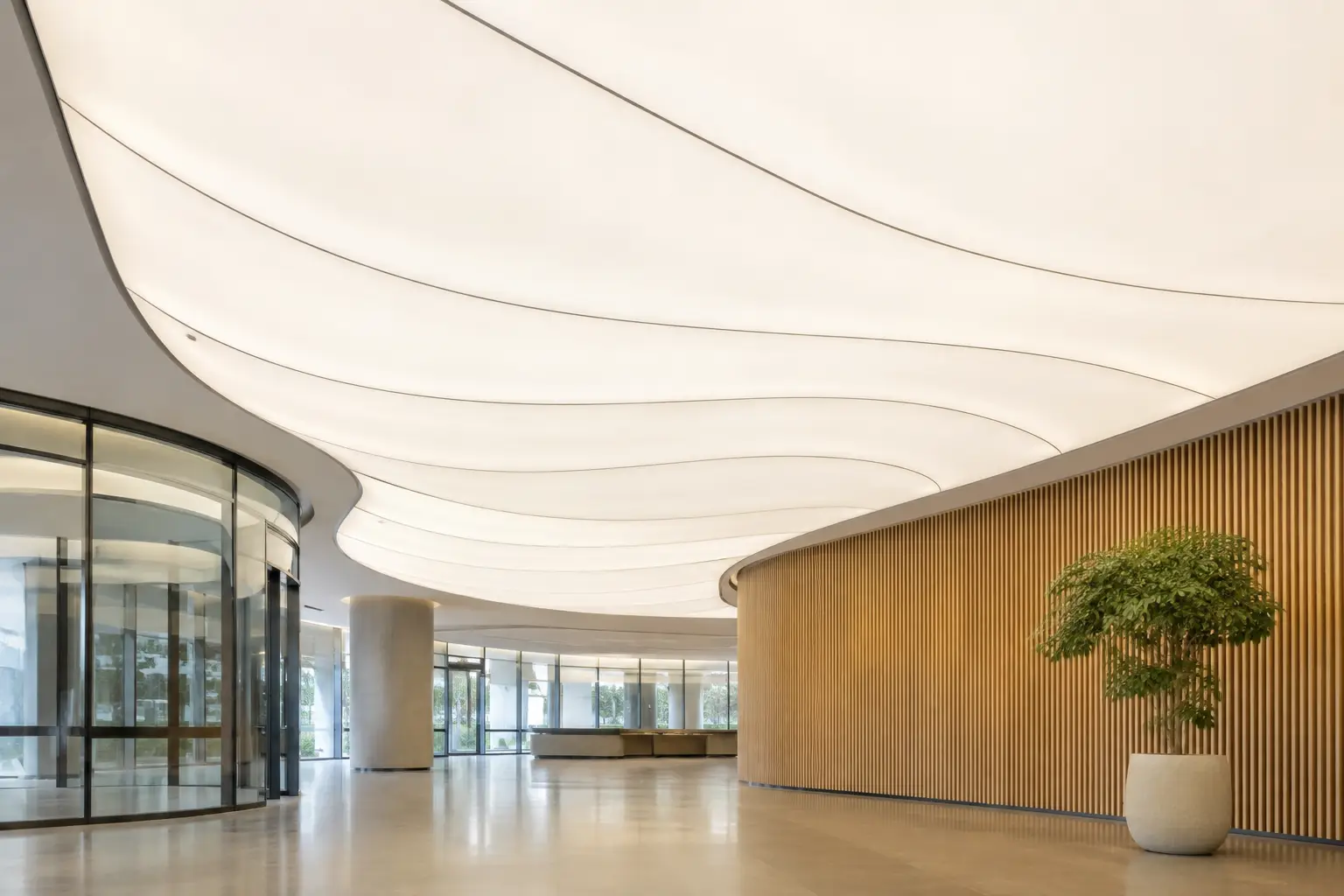
How to Specify Luminous Ceiling Membranes
A luminous ceiling is not simply a light fixture stretched across a room. It is an architectural surface that must work simultaneously as a light source, visual plane, and service interface. To specify Vecta Design stretch ceilings successfully, architects and lighting designers should coordinate the membrane, perimeter profile, cavity depth, LED layout, controls, access strategy, and surrounding finishes from the beginning.
When these elements are resolved together, the result is a calm, evenly illuminated plane without visible technical clutter. When they are not, even a high-quality system may reveal hotspots, dark edges, uneven tension, or poorly planned maintenance access.
Start with the Architectural Intent
Define what the luminous ceiling needs to achieve before selecting a membrane or profile. It may provide ambient illumination across a lobby, form a luminous feature above reception, make a windowless corridor feel more spacious, or create a controlled ceiling field in hospitality interiors.
Each purpose affects brightness, scale, color temperature, zoning, and surface finish. Large luminous planes can make compact spaces feel more open and reduce the visual fragmentation caused by conventional downlights. In retail and workplaces, they provide broad, low-glare ambient light. In hospitality, softly illuminated surfaces support atmosphere without competing with the interior concept.
The geometry also matters. A luminous ceiling may be flush with gypsum board, recessed, floating, or extended into walls and curved surfaces. Perimeter details determine how precisely the ceiling meets the surrounding architecture.
Specify Vecta Design Stretch Ceilings as a Complete System
The membrane should be specified as one component of an integrated system. Its translucency, color, width, tensioning method, seam layout, and compatibility with profiles all influence the final appearance.
A diffusing translucent membrane is typically used to soften LED sources and create a uniform luminous field. Higher translucency can improve light output but may require greater cavity depth or closer LED spacing to prevent visible source imaging. Denser diffusion improves uniformity but may reduce transmission and increase required lighting output.
The correct solution cannot be judged from a small sample alone. Review the membrane with the proposed LEDs, at the intended viewing distance, preferably using a representative mockup.
Color should also be tested early. Neutral white supports a crisp architectural character, while warmer tones often suit hospitality and residential spaces. Tunable white and color-changing systems should be reviewed across their full operating range.
Design for Uniform Light, Not Just Output
More lumens do not automatically create a better ceiling. The objective is controlled luminance and even diffusion across the visible surface.
Coordinate LED spacing with membrane transmission and cavity depth. Greater distance between LEDs and membrane usually improves blending, although available ceiling height, structure, mechanical services, and budget may limit the plenum. Shallower cavities may require closer spacing, improved optics, or a revised lighting strategy.
Perimeter conditions require particular attention. A ceiling may appear uniform at its center while becoming darker near profiles. Lighting layouts should therefore respond to the actual geometry, including corners, curves, narrow returns, and level changes.
Set measurable criteria such as target illuminance, color temperature, color rendering, dimming range, flicker performance, and control protocol. Review the ceiling both at full output and at the lower levels likely to be used in practice.
Consider Glare and Reflections
A diffuse membrane can reduce direct glare compared with exposed point sources, but it still becomes a bright surface. Review sightlines from reception counters, seating areas, beds, mirrors, glazing, and polished finishes.
Restaurants and lounges may benefit from lower luminance, while retail, fitting rooms, or clinical interiors may require higher output. Reflections in mirrors, glossy furniture, dark glazing, and screens should also be considered as part of the overall design.
Detail Profiles, Structure, and Services
The profile establishes the visible line and holds the tensioned membrane. Specify profiles according to the required edge condition, substrate, and installation sequence.
Structural support must be verified independently for profiles, lighting, access panels, and suspended services. Vecta Design stretch ceilings are lightweight, but the overall assembly still requires properly engineered support.
Drivers, power supplies, control equipment, sensors, fire devices, HVAC components, and junctions all need planned access. Access may be provided through demountable membrane areas, adjacent ceiling zones, or dedicated openings.
Avoid placing every device directly through the luminous plane. Sprinklers, speakers, cameras, detectors, and diffusers should be coordinated to preserve the ceiling’s visual clarity while meeting technical requirements.
Coordinate Acoustics and Environmental Performance
Luminous ceilings should not compromise acoustic comfort. In restaurants, offices, meeting spaces, and hospitality interiors, coordinate luminous areas with acoustic ceiling zones, wall absorbers, perforated systems, or other treatments.
Environmental conditions must also be considered. Check temperature around LEDs and drivers, especially in enclosed plenums. Humidity, cleaning requirements, and airborne contaminants are important for pools, spas, marine interiors, food-service spaces, and healthcare environments.
Use Mockups to Protect the Final Result
A small sample confirms color and material. A mockup confirms the architecture.
Build a representative section with the proposed profile, membrane, LED layout, cavity depth, controls, and adjacent finish. Check source visibility, edge falloff, color consistency, wrinkles, profile alignment, reflections, and performance at different dimming levels.
Mockups also help installers, electricians, and ceiling specialists agree on tolerances and sequencing before installation begins.
Write a Specification That Can Be Built
A strong specification should define both visual appearance and technical performance. Include membrane type, finish, profile configuration, lighting criteria, controls, structural coordination, access, trade interfaces, and mockup requirements.
Do not use “backlit stretch ceiling” as a complete description. For Vecta Design stretch ceilings, define the required standard clearly: a continuous tensioned membrane, uniform illumination without visible LED points, precise perimeter alignment, coordinated penetrations, and reliable service access.
The final goal is simple: the ceiling should remain intentional when dimmed, cleaned, maintained, and viewed from every important angle.